


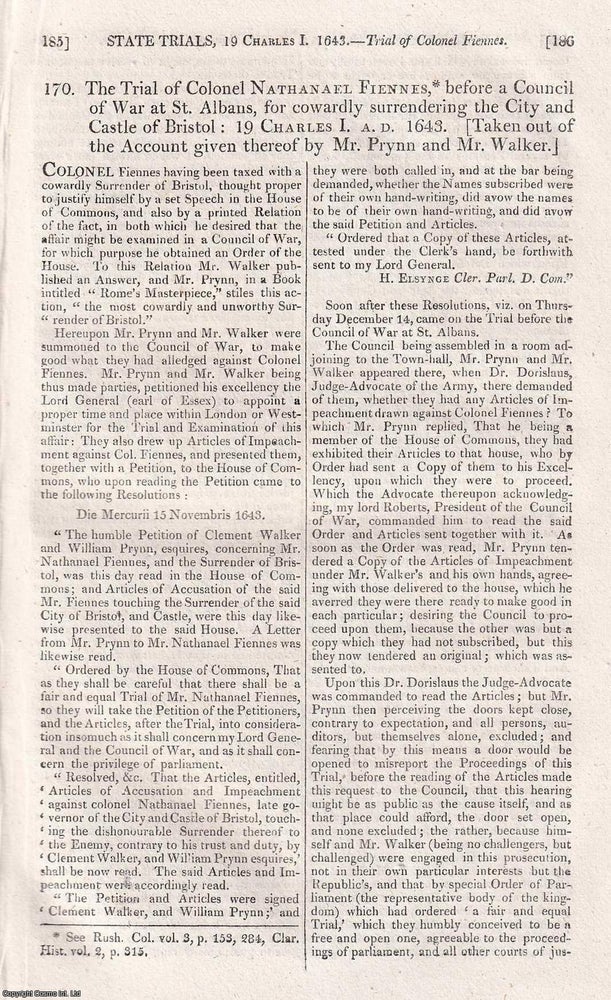


The Trial of Colonel Nathanael Fiennes, before a Council of War at St Albans, for cowardly surrendring the City and Castle of Bristol, the 14th of December 1643. Taken out of the Account given thereof by Mr Prynn and Mr Walker. An Original Trial Report from Cobbett's State Trials, part of the great 19th-century archive of courtroom history.
London: Cobbett's State Trials, 1809. Booklet - Unbound Pages. Very Good Condition. Item #373763
In December 1643, Colonel Nathanael Fiennes stood trial before a Council of War at St Albans, accused of cowardice for his controversial surrender of Bristol to Royalist forces earlier that summer. As Governor of the city, Fiennes had faced Prince Rupert's assault with limited resources, and though the defence was spirited, the capitulation came swiftly, too swiftly, in the eyes of many Parliamentarians. The loss of Bristol, a vital port and strategic stronghold, sent shockwaves through Parliament, prompting fierce criticism from William Prynn and Clement Walker, both of whom saw the surrender as emblematic of deeper failings within the Independent faction. Prynn and Walker spearheaded the campaign against Fiennes, publishing scathing pamphlets and pressing for formal accountability. Their efforts culminated in a trial that blended military justice with political theatre. Fiennes was found guilty and sentenced to death, though the sentence was never carried out. He would later be exonerated and return to public life under Cromwell's Protectorate. The episode remains a vivid illustration of how battlefield decisions could become lightning rods for ideological conflict, with pamphleteers like Prynn and Walker shaping public perception as much as any court martial. 66 pages, printed in double columns. Printed between 1809 and 1826, these historic documents are vivid extracts from Cobbett's State Trials; pages from the courtroom record that preserve the voices, arguments, and verdicts which helped shape the course of British justice and still echo through its constitutional legacy. Over two centuries old, each leaf is a tangible fragment of legal history, compelling, original, and rarely encountered outside institutional collections. These are not reprints or replicas, but authentic 19th-century printings that are rich in drama, and steeped in history. This particular trial report has been removed from a volume of Cobbett's State Trials and is now preserved in a modern card cover for practicality - an unassuming but serviceable presentation that favours function over finery. Size: 15 x 25 cms. Category: State Trials; State Trials::Octavo;.
Keywords: BZDB395 "Nathanael Fiennes, Bristol Surrender, Council of War, Civil War, 1643" State Trials; State Trials::Octavo; 1643 : THE SURRENDER OF BRISTOL: HONOUR, BLAME, AND THE PARLIAMENTARIAN DIVIDE The Trial of Colonel Nathanael Fiennes, before a Counci
Price: £19.95